


The Boy Who Remembered a Life He Never Lived

The Strange Case of James Leininger
Most two-year-olds are busy watching cartoons, refusing to eat anything that isn't beige, and finding creative new ways to injure themselves.
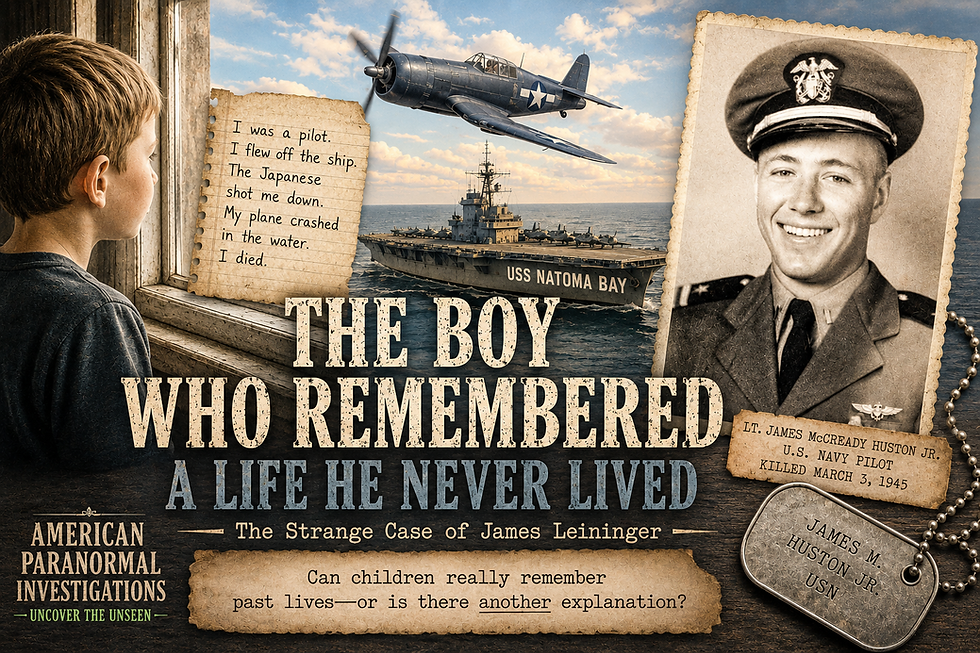
James Leininger was having nightmares about dying in a plane crash.
And not just the occasional bad dream.
According to his parents, James would wake up screaming, thrashing around and describing a burning airplane. Eventually, he began saying things that caught their attention.
He said he had been a pilot.
He flew off a boat.
The Japanese shot him down.
His plane crashed into the water.
And he died.
Okay.
That's a little harder to blame on a scary episode of Paw Patrol.
But what happened next turned a child's nightmares into one of the most talked-
about alleged reincarnation cases in America.
It Started With Nightmares
James was born in 1998 to Bruce and Andrea Leininger in Louisiana. Around the time he turned two, he began experiencing recurring nightmares involving an airplane crash.
His parents said James seemed unusually interested in airplanes and began making comments about World War II aircraft that seemed strange coming from such a young child.
At first, his father Bruce wasn't buying the reincarnation idea.
He started researching instead.
And eventually, the family began connecting things James had reportedly said to a real World War II aircraft carrier:
USS Natoma Bay.
That's when this story takes a pretty wild turn.
There Really Was a James
As Bruce continued researching the Natoma Bay, he eventually learned about a young Navy pilot named James M. Huston Jr.
Huston served aboard the USS Natoma Bay during World War II.
On March 3, 1945, while flying a combat mission near Iwo Jima, Huston's aircraft was shot down and he was killed.
He was 21 years old.
The Leiningers came to believe that their little boy wasn't simply having nightmares about a plane crash.
They believed he was remembering Huston's death.
And if the story ended there, I'd probably chalk it up to one very strange coincidence.
It doesn't.
The Details That Made People Pay Attention
Over time, the Leiningers attributed a number of statements and behaviors to James that they believed corresponded with Huston's life and death.
The case eventually caught the attention of psychiatrist Dr. Jim B. Tucker at the University of Virginia's Division of Perceptual Studies, which has spent decades studying reports of children who claim memories of previous lives.
Tucker published a case report about James in 2016.
One of the most important parts of his investigation involved something researchers call “early-bird” statements — things a child reportedly said before anyone identified the deceased person the child supposedly remembered.
That's important for an obvious reason.
If someone finds James Huston's biography first and then starts noticing that a child's statements match his life, we have a problem.
You can unintentionally start fitting the story to the person.
But Tucker reported that some of James's statements had been documented before the Leiningers identified Huston, including material captured during a television interview with his parents that was recorded but never aired.
That makes the case considerably harder to simply shrug off.
It does not, however, prove reincarnation.
And this is where our rabbit hole gets deeper.
Not Everyone Is Convinced
Years later, philosopher Michael Sudduth took another look at the case.
And when I say another look, I don't mean he skimmed the book and wrote an angry Reddit comment.
He spent roughly two years investigating it and published a lengthy critique in the Journal of Scientific Exploration.
Sudduth argued that there were ordinary ways James could have learned at least some of the information attributed to him.
James had watched aviation videos.
He had visited an aviation museum.
He had been exposed to World War II aircraft and imagery.
Sudduth also questioned whether the timeline presented by the family was as solid as it appeared and raised concerns about how conversations with James — including guidance the parents received from a past-life therapist — might have influenced the story as it developed.
His conclusion was pretty straightforward:
He did not believe the Leininger case provided good evidence for reincarnation.
Case closed?
Not quite.
Then Researchers Started Arguing About the Skeptic
Jim Tucker responded to Sudduth's criticism.
Then researcher James G. Matlock went back through dated emails and other records relating to the case and published his own analysis.
Matlock argued that those records established a more reliable timeline and that some of Sudduth's criticisms were based on an incorrect chronology.
So now we have researchers debating the evidence, the timeline, what James could have known, when he could have known it and how much weight any of it deserves.
Which, honestly, is exactly what should happen with a claim this extraordinary.
Because “a two-year-old remembered his previous life as a WWII pilot” is a pretty enormous statement.
We should be trying to poke holes in it.
If the evidence survives, it becomes more interesting.
If it doesn't, we learned something too.
James Isn't the Only Child With a Story Like This
This is where the subject gets even stranger.
Researchers at the University of Virginia's Division of Perceptual Studies have investigated numerous cases involving young children who spontaneously report apparent memories of previous lives.
The stories vary, but researchers have reported recurring patterns: children beginning to speak about another life at a very young age, describing people or places their families say they shouldn't know, displaying unusual behaviors or fears, and then gradually losing those apparent memories as they get older.
Again, none of that means reincarnation has been scientifically proven.
But there have been enough reports for researchers to spend decades asking what exactly is happening.
And I think that's the more interesting question anyway.
So… Did James Remember a Past Life?
I don't know.
And after reading both sides of this case, I'm not going to pretend I do.
There are things about James's story that are genuinely fascinating.
There are also legitimate questions about what information he may have encountered normally, how accurately the timeline was reconstructed and whether adults around him unintentionally influenced the story.
That's not nearly as satisfying as declaring REINCARNATION PROVEN!
But that's investigation.
Maybe James Leininger somehow remembered the final moments of a young pilot who died more than 50 years before he was born.
Maybe childhood imagination, exposure to aviation material, parental interpretation and coincidence slowly combined into an incredibly convincing story.
Or maybe whatever was happening falls somewhere we don't have a neat explanation for yet.
What I find most interesting is that after all these years, people are still arguing about this case.
Researchers have examined it.
Skeptics have challenged it.
Other researchers have challenged the skeptics.
And we're still left with a little boy who woke up terrified of a plane crash and a real WWII pilot whose story his family believed they eventually found.
So was James remembering a life he had already lived?
Or did a remarkable series of circumstances create one of the most convincing reincarnation stories ever told?
We'll let you decide.
Because if there's one thing we've learned from investigating the unexplained, it's that the answer you want isn't always the answer the evidence gives you.
And sometimes...
the evidence leaves you with even more questions.


Comments